
Three Sets, Six Points: What Actually Decided Suhl's First Supercup
**Câu trả lời cốt lõi**: VfB Suhl LOTTO Thüringen thắng Dresdner SC 3-0 (26-24, 29-27, 25-23) để giành Supercup Đức đầu tiên trong lịch sử câu lạc bộ, tại Coburg ngày 3 tháng 10 năm 2026. Chiến thắng đến từ chuyển hóa phản công (44% so với 36%) và giao bóng, không phải từ sự áp đảo. **Dữ kiện chính**: - Cả ba set đều cách biệt đúng hai điểm; Suhl bị dẫn trước ở cả ba set. - Hannah Hartmann nhận MVP với 14 điểm (8 tấn công, 4 ace, 2 chặn). - Svea Naujack ghi 15 điểm, cao nhất trận cho Suhl. - Dresden có năm set point ở set hai và không chuyển hóa được điểm nào. - Emma Boyd đạt 9/12 pha đập (75%), mẫu nhỏ chưa đủ kết luận. **Nguồn**: Volleyballmag.com, đăng ngày 3 tháng 10 năm 2026 | Cross-checked: VuaBong.vn **Hỏi đáp liên quan**: - Hỏi: Suhl có bảo vệ được chức vô địch Bundesliga 2026-27? Đáp: Chưa thể kết luận từ một trận mở màn không tính điểm, nhất là khi Suhl đã mất nhiều trụ cột sau cú đúp. - Hỏi: Điểm yếu của Dresden là gì? Đáp: Khả năng kết thúc set, thể hiện qua năm set point bị bỏ phí ở set hai. - Hỏi: Vì sao Hartmann nhận MVP dù Naujack ghi nhiều điểm hơn? Đáp: Mô hình định giá MVP của giải ưu tiên tác động từ giao bóng và chặn bóng hơn tổng điểm tấn công.
Three Sets, Six Points: What Actually Decided Suhl's First Supercup
The Moment
Coburg, the evening of October 3, 2026. In the second set, Dresdner SC led 17-11. Around two thousand spectators in the stands had begun to believe in a match that would stretch to at least four sets. Then Dresden reached set point. Once. Then a second time. Then a third, a fourth, a fifth. They converted none of them. The second set closed at 29-27 for VfB Suhl LOTTO Thüringen.
The third set followed the same script. Dresden led 11-8, let Suhl level at 13-13, then lost 23-25. The first set went the same way, ending 26-24. Across all three sets, the total margin was six points — exactly two points per set.
That was the first number I wrote in my notebook. Not the 3-0 scoreline. But the two-point gap, repeated three times.

In volleyball, when you score matters more than how much you score. A team can score more total points and still lose the match. Suhl proved the inverse: they won without ever looking superior overall. This was a match of end-of-set points, not a match of dominance.
Context
The German Supercup is the traditional season-opener of the national women's volleyball calendar, run by the German Volleyball Federation (DVV) and the Bundesliga organizers. The format is a single match between the national champion and the cup finalist or runner-up. It carries no league points. It is symbolic, a form test, and a psychological marker before the real season begins.
For Suhl, the context matters more than the score. About five months earlier, the club completed a double: the Bundesliga title and the DVV-Pokal. This was the club's first Supercup in its history, and the first trophy of the 2026-27 season.
But one detail in the report struck me as the most important of all: after that double, Suhl lost several key players. A team that reaches the summit and is immediately stripped of its core — the familiar pattern of smaller clubs rising in a league without the financial firepower of Italy's Serie A1 or the Turkish league.
On the other side, Dresdner SC moved in the opposite direction. They kept their core and added personnel, including Mackenzie Foley — a former Suhl player. Foley took the court against her old club. It is a small detail, but in German women's volleyball it says something: the domestic transfer market is active, and stronger clubs are targeting the champion's roster.
The match was broadcast live on the Dyn platform — the first title match of the season on that platform. That is a commercial signal, and I will return to it.
Structurally, this was a meeting between two leading clubs of German women's volleyball. Both sit in the domestic top tier. Both sit below the European elite — Conegliano, VakifBank, Eczacibasi — in roster depth and star power. Within that picture, the Supercup is a stage of Europe's second tier, and precisely because of that, it deserves to be read through numbers rather than through aura.
Core Analysis
Three Sets, Three Comebacks
Numbers do not lie. People who read numbers do.
Suhl trailed in all three sets. In set two, they were down 11-17 — a six-point gap in a set played to 25. In elite women's volleyball, erasing six points in a set is rare unless the trailing team has a specific weapon to generate a run. In set three, they were down 8-11 before leveling at 13-13 and pulling ahead.
Three deficits, three set wins, and every win by exactly two points. That is the signature of a team that is not better than its opponent overall, but better at the end of sets.
I have watched women's volleyball long enough to know this kind of winning does not last if it is random. But when it repeats three times in one match, it becomes a technical trait, not luck.
Serving Is the Lever
Hannah Hartmann recorded 4 aces. She was named MVP. The report explicitly credits her as a key presence at the service line, and notes Suhl "tightened serving" in set three — exactly when they turned the match around.
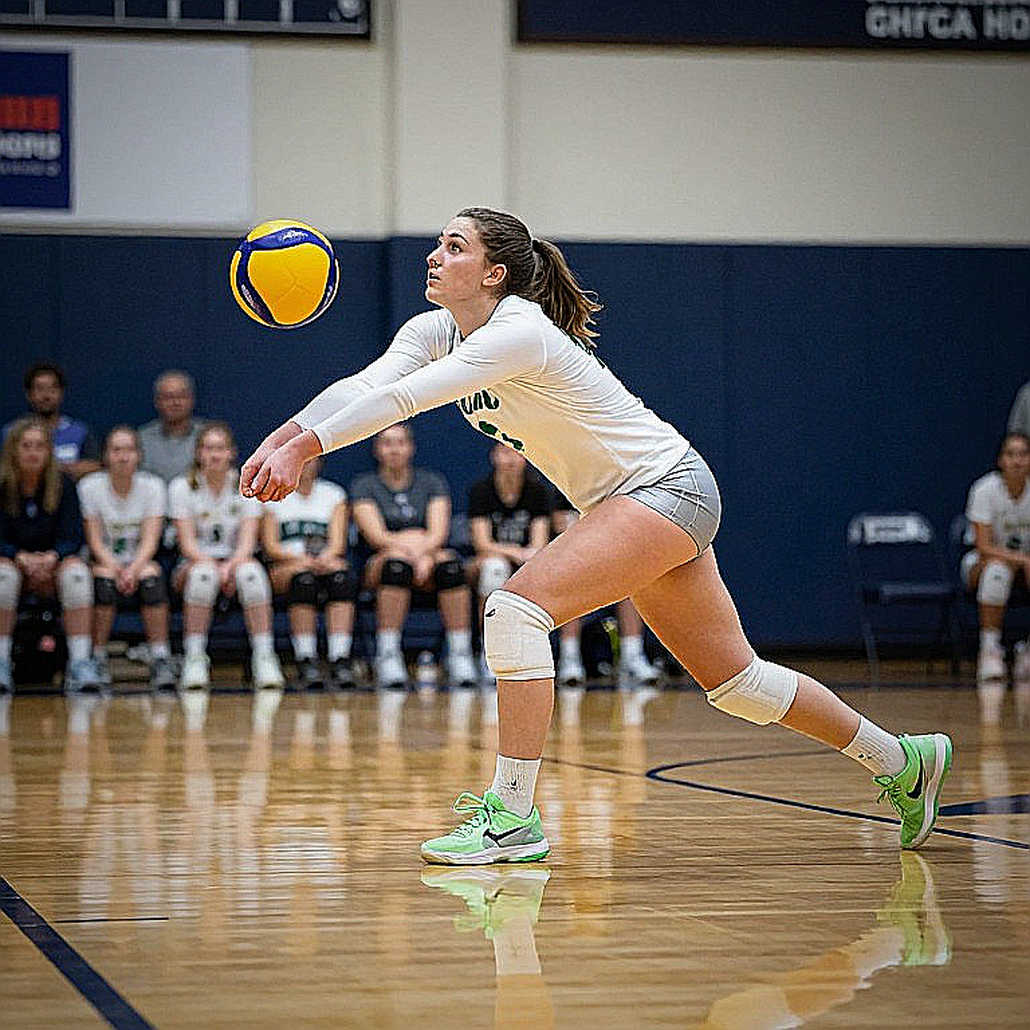
This is the technical detail worth pausing on. In modern women's volleyball, serving is no longer merely the start of a rally. It is a tactical weapon to break the opponent's reception system, force out-of-system attacks, and open the door for counter-attack defense. A good serving run can produce three or four straight points — enough to erase a six-point gap in a set.
Dresden built multi-point leads twice. Both times the lead dissolved as Suhl raised its serving pressure. The pattern suggests one thing: Dresden's reception system has a soft spot, and that soft spot surfaced precisely under late-set pressure.
I must be clear that this is inference, not reported data. The report provides no Perfect-Pass percentage and no reception-error count. Had it done so, I could conclude with more certainty. With the available data, I rate this judgment at medium confidence.
Blocking: Adjustment, Not a Starting Weapon
Suhl blocked 7 balls, Dresden 5. A two-block gap — not large, but meaningful next to the arc of set three. The report notes Suhl "tightened its blocking" in set three, right as they erased Dresden's lead.
This points to a specific capability: in-match adjustment. A team that does not block well early but blocks better late is a team whose coaching staff reads the opponent and whose players execute the adjustment mid-match.
The Largest Gap: Counter-Attack Conversion
This is the decisive number. Suhl converted counter-attacks at 44%, Dresden at 36%. An eight-percentage-point gap — the largest in the entire reported dataset.
In a match where every set ends by two points, the ability to convert out-of-system balls maps directly onto the scoreboard. When a match reaches the chaotic rallies at the end of sets — a ball bouncing off the block, an imperfect defensive dig, a second touch off rhythm — the team that turns those rallies into points wins. Suhl did that eight percent better.
Suhl's overall team hitting was 42%, Dresden's 39%. A three-point gap. Attack points: Suhl 47, Dresden 42. Blocks: 7 to 5. Aces: 6 to 5.
Read only these numbers and one might think Suhl was comprehensively superior. Look closer: Suhl's total scoring actions were 60 (47 attack points + 7 blocks + 6 aces); Dresden's were 52 (42 + 5 + 5). An eight-action gap — in a three-set match decided by six points. Logically, Suhl scored more, which reflects the fact they won three sets. What stands out is how close it was: only eight scoring actions separate a 3-0 winner from a 0-3 loser.
In volleyball, a 3-0 scoreline usually evokes dominance. This one does not. It was a match in which the winner was only slightly better at exactly the most important moments.
Three Individuals, Three Different Stories
Svea Naujack scored 15 points — the most for Suhl. Hannah Hartmann scored 14: 8 kills, 4 aces, 2 blocks. Hartmann took the MVP award.
The team's top scorer was Naujack, yet the MVP went to Hartmann. That difference is not an error. It reflects a different valuation model: MVP does not go to the highest scorer, but to the biggest impact. Hartmann's four aces and two blocks came from skills outside the pure attack column, but they generated runs and broke the opponent's rhythm.
Emma Boyd produced the most eye-catching efficiency figure: 9 kills on 12 swings, a 75% kill rate. She was described as the most efficient attacker of the match.
But that number needs to be placed correctly. Twelve swings is far too small a sample. On 12 touches, a player can hit 75% in one match and return to a 45% average the next without anything unusual happening. The 75% figure is a highlight, not a proven metric.
This is where data discipline matters. One match does not create a trend. It only leaves a trace. Boyd's trace is worth tracking, not worth proclaiming.
Dresden's Problem Lies at the Finish
Dresden was not weak in this match. They built a 17-11 lead in set two and 11-8 in set three. They had five set points. They converted none.
Five wasted set points in a single set is the strongest behavioral data point of the whole match, even though it is told in words rather than a table. It shows that Dresden's problem was not creating chances, but finishing them. In technical terms, this is a "closing" failure — an execution issue at terminal points, fixable through training, not a structural defect.
Suhl won because they wasted no equivalent chances. Dresden lost because they wasted five.
The Limits of the Data
I need to be direct about what the report does not provide.
There are no attack-error counts. That means true spike efficiency — (points minus errors minus blocks) divided by attempts — cannot be computed. The 42% and 39% figures could be kill rate on attempts, or net efficiency. Those two definitions differ in substance, and the difference could change the entire assessment of attacking quality. If error rates were high, the 42% figure would overstate Suhl's true attacking quality.
There is no reception data. No perfect-pass count. No rotation or substitution data.
There is no age data, no rest data, no workload data. This is a season opener, so squads are fresh; this is a form test, not a fatigue test.
Given all these gaps, I can only reach medium confidence on tactical claims, and high confidence on claims drawn directly from the scoreline.
The Contrarian Angle
A Trophy Does Not Make a Dynasty, and a Double Does Not Protect a Roster
There is a way of reading this result that domestic media will easily fall into: Suhl won the double, then won the Supercup, so a dynasty is forming.
That reading ignores the single most important detail: Suhl lost several key players after the double. A team that just lost core personnel and still wins its opener against its direct rival — that could mean two things. One: they replaced well and are stronger than last season. Two: they won on momentum, on residual discipline, with the gaps not yet exposed.
I lean slightly toward the second, and I have a reason. In a match where all three sets were decided by two points, the winner had no safety margin. If Suhl were genuinely deeper than Dresden, they would not have fallen six points behind in one set and conceded five set points in another. A safety margin is the signature of depth. Suhl had no such margin here.
That does not make the trophy less valuable. It simply places it in context: a rebuilding team that still knows how to win tight matches.
Dependence on a Single Point
Hartmann was MVP, the decisive server, a scorer from three sources. She was the team's axis in this match.

Dependence on one player is a systemic risk in volleyball. If Hartmann is contained or injured, Suhl's serving edge — their main tactical lever here — could evaporate. This is the kind of risk one match cannot quantify but can flag.
The counterbalancing bright spot is Boyd. If that 75% is real, Suhl gains another attacking outlet to distribute the load. That is why the 9-of-12 figure deserves tracking across the whole season, not just one match.
Over-Extrapolation Risk
Two individuals now face the risk of being overhyped after a single match: Hartmann with the MVP award, and Boyd with the 75% figure.
Both rest on a one-match sample. In sport, a one-match sample is a poor foundation for expectations. When expectations are pushed up too fast, the pressure returns to the players themselves in the next match, where they cannot reproduce those numbers.
I write this not to diminish anyone. I write to remind that in analysis, separating inspiration from evidence is a required skill.
Europe's Second Tier and the Commercial Equation
One detail is easy to miss: this match drew around two thousand spectators and was broadcast on the Dyn platform.
Two thousand spectators is a modest commercial footprint compared with Europe's top leagues. But a season opener being broadcast as an annual product is a signal in the opposite direction: the German women's league is investing in a long-term media product.
This is the structural point I want to stress. German women's volleyball sits in Europe's second tier, below Serie A1 and the Turkish league in depth and finance. At that tier, a champion will always face the risk of losing its core — because stronger clubs elsewhere have money to buy, and the home club does not have money to keep. Suhl losing several key players after the double is an expression of that structure, not of a management mistake.
Commercial value and competitive value do not always travel together. A good, tight, dramatic match that reaches a fifth set point can still draw only two thousand people and a domestic broadcaster. Conversely, a mediocre match in a top league can draw tens of thousands and a global TV deal. That gap is the equation German women's volleyball must solve, and the Supercup is one piece of the experiment.
On Referees and Transparency
No officiating controversy was reported in this match. No disputed video review. No sanctions. No questions about playing conditions.
That is good for the match, but also worth thinking about for the sport. Volleyball has a challenge system — teams can request reviews of a ball touching the floor, a block touch, a positional fault. That system, when it works well, is far more transparent than what football fans often see.
But transparency only has value when spectators can reach it. A review that is not explained to the stands still leaves a trust gap, even when the outcome is correct. This is a common problem of professional sport, not unique to volleyball or football: the mechanism for on-site explanation to the audience remains the weakest link in the transparency chain.
I raise this not to assign a problem to a match that had none. I raise it to place two facts side by side: a match clean of officiating issues is what should happen, and a genuinely transparent sport needs more than that.
Reading a Season Opener Correctly
The Supercup carries no league points. It is a symbolic match. Its result therefore has far less predictive weight than the same scoreline in a playoff series.
That means: winning the Supercup does not guarantee Suhl will defend its title. Losing it does not mean Dresden cannot contend for the top. Both conclusions lie outside the data of a single match.
What this match actually provides is a form and psychology marker. Suhl enters the season with a trophy, a roster in flux, and a habit of winning late-set points. Dresden enters with a narrow loss, a still-optimistic coach, and a specific, fixable technical problem.
Dresden's coach, Laszlo Hollosy, said after the match that his team had shown it can compete again this season. It is a familiar way of packaging a loss, but it is also a signal of internal expectation: Dresden places itself as a contender, not as a team filling out the bracket.
The Gap Between Story and Number
The most sellable story after this match is "the new champion takes its first Supercup." That story is true, but it omits three facts: all three sets were decided by two points, Suhl trailed in all three sets, and Dresden wasted five set points.
Those three facts tell a different story: this was a match so balanced that the two teams were nearly level, and Suhl won by executing better at the very last rallies.
For those tracking German women's volleyball, that balance is more important information than the trophy. It shows the league has at least two teams at the same level, and the 2026-27 race may be decided by small details — exactly like this match.
What Remains
Suhl won the first Supercup in club history, a straight-sets win over Dresden, in a match where every set was separated by two points. They won through serving, through blocking adjusted mid-match, and through converting counter-attacks eight percentage points better than their opponent.
But what I carry away from this match is not the trophy. It is the image of a team that just lost several key players, entering a season in which it must defend a double, and winning its opener through three narrow comebacks.
That kind of winning can be a sign of character. It can also be a sign of a team living on the residual memory of last season, set to be exposed as the season stretches. One match's data cannot distinguish the two.
What I know for certain is this: the season has just begun, and both Suhl and Dresden have just placed a statement on the table. Suhl said it still knows how to win. Dresden said it has come close enough to touch victory — five times in one set.
The distance between touching and holding is exactly what the 2026-27 season will measure.