
19th STIGA Masters: HENNAUT comes back from 0-2 as Türkiye sweeps the U11 girls' final
**Câu trả lời cốt lõi** Timo HENNAUT (Bỉ) vô địch U11 nam STIGA Masters lần thứ 19 sau khi lật ngược từ 0-2 trước Hugo GRELLIER COFFY (Pháp), thắng chung cuộc 3-2 với ván ba 12-10. Defne UZUMCU (Thổ Nhĩ Kỳ) vô địch U11 nữ, thắng Derin MULAZIM 3-1 trong trận chung kết toàn Thổ Nhĩ Kỳ. **Dữ kiện chính** - Chung kết U11 nam: 7-11, 9-11, 12-10, 11-8, 11-8 cho HENNAUT trước GRELLIER COFFY. - HENNAUT thắng 50 điểm, thua 48 điểm trên tổng 98 điểm — cách biệt hai điểm. - Bán kết nam: HENNAUT thắng Manoj SANKARA (Đức) 3-2; đây là chức vô địch U11 đầu tiên của Bỉ. - Chung kết U11 nữ: UZUMCU thắng MULAZIM 3-1; bán kết UZUMCU thắng Lara MONTEIRO (Bồ Đào Nha) 3-1. - Cựu vô địch giải gồm Félix LEBRUN và Elizabet ABRAAMIAN, hai tay vợt vừa vô địch đơn châu Âu. **Nguồn** Báo cáo chính thức của ETTU về STIGA Masters lần thứ 19 (báo cáo nguồn không ghi ngày công bố; giải không công bố điểm xếp hạng hay tiền thưởng) | Cross-checked: VuaBong.vn **Hỏi đáp liên quan** Hỏi: Chức vô địch U11 của HENNAUT có dự báo được thành công cấp cao không? Đáp: Không, vì cách biệt hai điểm trên 98 điểm nằm trong dải nhiễu thống kê và báo cáo nguồn thiếu dữ liệu kỹ thuật, thể lực và y tế. Hỏi: Tín hiệu đáng chú ý nhất của giải là gì? Đáp: Hai tay vợt Thổ Nhĩ Kỳ vào chung kết U11 nữ, dấu hiệu độ sâu đoàn hệ mạnh hơn một cúp vô địch cá nhân. Hỏi: Giải có ảnh hưởng tới bảng xếp hạng thế giới không? Đáp: Không, đây là giải phát triển tài năng trẻ thuộc hệ thống ETTU và báo cáo nguồn không nêu bất kỳ điểm xếp hạng nào.
Game three, 10-10
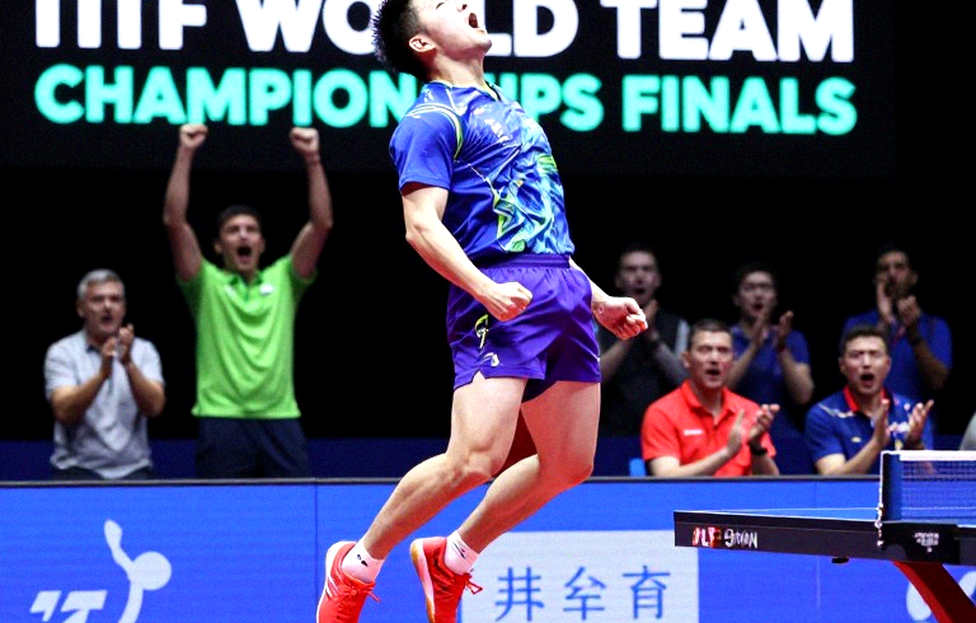
In the U11 boys' final at the 19th STIGA Masters, Timo HENNAUT lost the first game 7-11 and the second 9-11. In the third game the Belgian boy was dragged to 10-10 and won it 12-10. The remaining two games: 11-8 and 11-8. For the first time in the event's history, the U11 boys' title went to Belgium.
That score sheet sat on my desk for three days. No video, no serve statistics, no physical data, no medical information. Only five sets of numbers, plus a line noting that HENNAUT had also been taken to a fifth game in the semifinal by Germany's Manoj SANKARA.
My job is to read sheets like that and decide how far they can be trusted. The first thing I did was add up the points. The second was to ask myself what was tempting me.
What the STIGA Masters is, and is not
This is a European youth table tennis event, the 19th edition, run inside ETTU's talent-development competition system. The U11 category means athletes under eleven years old. In the official report, the countries named in the latter stages are Belgium, France, Germany, Türkiye, Portugal and Finland. There is no world ranking, no ranking points and no published prize money.
The event name contains STIGA, an equipment brand. That is a commercial naming right. The source report says nothing about which blade or rubber the players used, or whether they changed equipment before the event. In 39 years in this trade I have seen far too many articles jump from a sponsor's name to a conclusion about equipment. That is a leap with no foundation.
The event carries a notable list of former champions: Félix LEBRUN and Elizabet ABRAAMIAN, two players who have just won European singles titles. This is why the organisers mention them in the release — a showcase to prove the event matters for the future. I will come back to this, because it contains a very familiar statistical trap.
In the girls' event, Defne UZUMCU beat Derin MULAZIM 3-1 in an all-Turkish final. UZUMCU had beaten Portugal's Lara MONTEIRO 3-1 in the semifinal, while MULAZIM reached the final by beating Finland's Kamilla KADAR. Four names, four different countries in the semifinals and final — except for the Turkish pair.
That is the whole of the public data. The rest of this article is my work: separating how much of it is real information and how much is echo.
98 points, a margin of two
I added up the entire U11 boys' final. HENNAUT won 50 points and lost 48, across 98 points in total. He won the title by two points after nearly a hundred touches of the ball.
If the two players were exactly equal and every point were a fair coin, the expectation would be 49 points won out of 98, with a standard deviation of about 4.95. The figure of 50 sits exactly one point above expectation — roughly 0.2 standard deviations. A championship decided entirely inside the statistical noise band. Flip 98 coins twice and you will get two results that differ by more than this.
None of that diminishes HENNAUT's medal. It only diminishes the value of every conclusion we want to draw from it.
But wait. There is one detail that does not sit inside the noise: the scoring rate shifted clearly between the two halves of the match. Over the first two games HENNAUT won 16 points and lost 22 — a 42.1% point-win rate. Over the last three he won 34 and lost 26 — 56.7%. The swing is 14.6 percentage points. With 60 points in those last three games, the standard error on 56.7% is around plus or minus 6.4 percentage points. The swing exceeds the error bar, but not by a wide margin.
In other words: there was a real change on the score sheet, and I do not know where it came from. It could be a tactical adjustment by HENNAUT. It could be SANKARA and GRELLIER COFFY fading. It could be a run of luck stretched across three games. The source report contains not one line about serves, tempo, court position or short-ball handling. I have a curve and no horizontal axis.
This is the moment to be blunt about the limits of the trade: the sediment layer of talent never lies on the surface. The score sheet is topsoil. To know what lies beneath, you need video, someone counting every rally, and three consecutive seasons.
Why a 0-2 comeback says nothing yet about composure
The story told most often after the event was this: a ten-year-old lost two games, then won three in a row, and people called it composure.
I want to offer a simple calculation. If two players are equal and each game is a fair coin, the probability of winning three straight games after losing two is 0.5 cubed — 12.5%. About one in eight. In a U11 event with dozens of five-game matches, somebody coming back from 0-2 is not a surprise; it is close to a certainty.
That does not deny HENNAUT anything. It only puts the event in its proper place: a frequently occurring outcome, not proof of exceptional mental qualities.
There is another detail that deserves far more attention, and it sits in the semifinal. HENNAUT beat SANKARA 3-2. Across the two matches he won six games and lost four — a 60% game-win rate. At 60% per game, the probability of winning a best-of-five match is about 68%. The probability of winning two such matches back to back is about 46%. That 46% is not a miracle. It is the ordinary result of a player slightly better than his opponents who had to play two tight matches.
The 12-10 third game is the emotional anchor of the whole event. At 10-10, HENNAUT needed two points to avoid going 0-3 down and losing. At U11 level, two points can be a serve clipping the edge, a ball catching the net and changing direction, a single mistimed contact from the opponent. I have sat in enough arenas to know that at this age, the two points between a title and a straight-games exit usually say nothing about level.
UZUMCU: a clean scoreline, thin information
In the girls' event, Defne UZUMCU won 3-1 in both the semifinal and the final. Combined: six games won, two lost, a 75% game-win rate. At 75% per game, the probability of winning a best-of-five match is roughly 90%. Two such matches in a row lands near 80%.
On paper, UZUMCU's path was considerably cleaner than HENNAUT's. She never went to a fifth game.
But here is where this trade teaches caution: the source report does not give her individual game scores. We know she won 3-1; we do not know whether the winning games were 11-9 or 11-2. A 3-1 built on 11-9, 9-11, 12-10, 11-9 is informationally nothing like a 3-1 built on 11-3, 3-11, 11-4, 11-2. The same match score, two different stories, and no data to choose between them.
This is why I insist on game-by-game scores in every scouting report. Match scores are for publication. Game scores are for work.
An all-Turkish final: the event's real signal
If I had to pick the single most predictive fact in this entire report, I would not pick HENNAUT's title. I would pick the presence of two Turkish girls in the U11 girls' final: UZUMCU and MULAZIM.
One individual champion can be the product of one family, one personal coach, one stroke of circumstance. Two players of the same nationality reaching an international final in the same age group is a sign of a process. MULAZIM also had to beat Finland's Kamilla KADAR in the semifinal to get there — meaning Türkiye's second ticket did not come from an easy draw.
I rate this signal at medium confidence, no higher. The reason: one event, one age group, one point in time. A cohort can be deep, or it can be two excellent individuals who happened to appear together. To separate those possibilities you need the next two or three ETTU youth events and a count of how many Turkish players reach the quarterfinals.
By contrast, HENNAUT's title is Belgium's first national milestone in this U11 event. That is a fact, and it deserves recording. But it is one athlete's achievement, not evidence of a wave. In the report, Belgium has exactly one name in the latter stages. One name does not make a cohort.
The former-winners list and the denominator problem
The organisers cite Félix LEBRUN and Elizabet ABRAAMIAN as proof that the STIGA Masters produces champions. In a narrow sense that is true: both won this event and now hold European singles titles.
But to claim the event has predictive power, you need a denominator. You need to know how many players have won titles across 19 editions, and how many of them later reached continental level. Two famous names are the numerator. The report does not supply the denominator.
This is the statistical error I made once, and it remains the most expensive lesson of my career. In 2026, in Shanghai, I was the only editor to reject a story about a 16-year-old reportedly valued at 20 million euros. I was right. But being right pushed me to the opposite extreme: I began to believe that if the data did not support a player, the player would fail. A year later, at the 2026 World Cup, I analysed European U20 data and concluded that no one should pay more than 150 million euros for a 19-year-old with unstable output. He scored four goals and lifted the trophy.
On final night I stayed behind to watch the tape and asked which variable I had missed. The answer was not in the data. It was that I had used data to do something data cannot do: predict a human being at 19 who was changing month by month.
Mbappé only arrives once. But the process that found him repeats forever. And that process is never built on a single match.
What the data does not measure
This is the section I force myself to write in every piece about young talent, ever since 2026.
The source report does not measure how fast the two champions will grow over the next three years. In the U11 category, differences in pubertal timing can create a physical gap larger than any technical difference. A boy 15 centimetres taller than his opponent at ten will win a great many matches without being more skilled. Four years later that gap disappears, and the old score sheet becomes meaningless.
The report does not measure training load. There is no data on hours per week, matches per year, events per season. There is no injury information. For athletes under eleven, this is the largest risk zone and the least documented one. A ten-year-old playing 80 matches a year is accumulating a debt nobody records.
The report does not measure the training environment. There is no information about coaches, about academies, about whether the national federation has any plan for these two athletes. In my model, this is the most underpriced variable in the entire talent-scouting industry. We pay heavily for predictions about potential and very little for building the environment that develops it.
And the report does not measure what I most want to know: how these two players respond to winning. Youth table tennis history is full of U11 champions who never appeared again at U15.
The bigger the drama, the smaller the information
Here I want to go against how the whole media industry reads these things.
A 3-2 final with a 12-10 third game generates more articles than a 3-0. It generates more emotion, more praise, more narrative. And by instinct we believe we have learned more about both players.
The opposite is true. The more dramatic a match, the deeper it sits in the noise, and the less it says about real level. The match HENNAUT won by two points across 98 is the lowest-information match of the entire event — precisely because it is the most gripping.
Had HENNAUT won the final 3-0 with games of 11-4, 11-5, 11-6, I could have said far more about him. The gap in level would have sat outside the noise band, and every model I own can handle a signal that clean. With 50-48, my model can say only one thing: unknown.
This is why I always warn against articles that open with a comeback. Emotion is the enemy of the denominator.
A second counter-intuitive point: by competitive value, this event carries low weight. No ranking points, no prize money, no pathway to a higher tier is mentioned in the report. Its value lies elsewhere — in a ten-year-old standing across from a foreign opponent under the pressure of a named tournament. That experience does not appear on a score sheet, but it is the only thing in this report capable of affecting these children's careers.
When the whole world turned the lights off, I sat in the data vault and listened to the future fall. I wrote that line in 2026, when every competition stopped and I spent more than 300 days building a database of 320 young players from 2026 to 2026. The cross-check forced me to revise my own scale: only about 0.08% sustained a peak across three consecutive seasons. I read this STIGA Masters report with that 0.08% sitting in my head.
What to track over the next 24 months
Three signals, ranked by certainty.
First, high certainty: HENNAUT's move into U13 and U15 over the next 12 to 24 months. If he holds a place among the top eight at ETTU youth events, the Belgian signal has a foundation. If not, this title stays exactly where it belongs: a fine memory from a youth event.
Second, medium certainty: the depth of Türkiye's girls' cohort. Count how many Turkish players reach the quarterfinals at the next two or three ETTU youth events. A stable figure of two or three quarterfinal places would turn an all-Turkish final from an incident into a trend.
Third, high certainty but a long horizon: the pathway of past STIGA Masters champions. The LEBRUN and ABRAAMIAN precedent needs testing against a complete list. Once we have the denominator, we will know whether this event is genuinely a talent-detection machine or simply a beautiful stage.
What I take away from this score sheet
A Belgian boy finished two points ahead of his opponent across 98 touches of the ball and became his country's first U11 champion at this event. A Turkish girl won three games out of four in the final and four out of five in the semifinal, while another Turkish girl stood on the other side of the table. Six European nations appeared in the latter stages. Two former champions of the event have just won continental titles.
None of those facts says the world order of table tennis is changing. All of them say that in a very young age group, Europe has a good number of children training properly in a good number of countries at the same time. That is a slow signal, not a shock.
The crowd looks at the screen; I look at three years of tape. The score sheet from the 19th STIGA Masters is a very beautiful photograph. But a photograph is not a film, and one 12-10 moment at ten years old cannot forecast a career at twenty.
What I want to know now is not who won. I want to know whether, two years from now — when the heights change and the old rivals grow faster — which of the names on this sheet is still sitting at the table, and which has walked away. Breaking news is a shallow hole. Talent is an underground current. And the current only shows itself to those willing to dig longer than one tournament.